Table of Contents
There is no single monthly electricity consumption figure that applies to every Australian household. Household power consumption varies significantly according to the number of people living in the home, climate, heating and cooling requirements, appliances, hot-water systems, property size and how electricity is used.
As a practical benchmark, current Energy Made Easy plan examples show electricity usage of around 11.9 kWh per day for a one-person household, 17.6 kWh per day for two to three people, and 26.9 kWh per day for four to five or more people. That equates to roughly 360 kWh, 535 kWh and 820 kWh per month, respectively, if those daily averages were maintained across a 30-day month. These figures are examples based on typical usage in particular postcodes, not a single national average.
The Australian Government’s Energy Made Easy service also makes clear that household electricity use can change throughout the year and that historical usage is generally a better indicator of future consumption than a generic benchmark.
What is the average household power consumption in Australia?
The most useful answer is to think in terms of household size and circumstances rather than one national monthly average.
| Household size | Example daily electricity use | Approx. 30-day consumption |
| 1 person | 11.9 kWh/day | 357 kWh/month |
| 2–3 people | 17.6 kWh/day | 528 kWh/month |
| 4–5+ people | 26.9 kWh/day | 807 kWh/month |
These monthly figures are calculated from the daily benchmark examples published through Energy Made Easy. Actual usage can be substantially higher or lower depending on the property, location, appliances and season.
It is also worth distinguishing electricity consumption from the amount shown on an electricity bill. Your bill measures electricity in kilowatt-hours (kWh). One kWh represents the amount of energy consumed by a 1-kilowatt appliance operating for one hour.
For example, a 2 kW heater operating continuously for three hours would consume approximately 6 kWh.
Why does household electricity consumption vary so much?
Two households with the same number of occupants can have very different electricity consumption.
Energy Made Easy identifies factors including the number of people in the home, the appliances installed and how those appliances are used. Seasonal conditions also influence consumption. A household in a cooler region may use substantially more electricity for heating in winter, while a household in a warmer climate can experience higher summer consumption because of air conditioning.
Some of the biggest influences include:
Household size
More people generally means more showers, cooking, refrigeration, washing, entertainment and other electricity use.
However, consumption does not necessarily increase in direct proportion to the number of occupants. Some appliances, such as refrigerators and freezers, consume electricity regardless of whether one or several people live in the home.
Heating and cooling
Heating and air conditioning can have a significant effect on household electricity consumption.
A home that uses reverse-cycle air conditioning extensively during summer and winter can consume considerably more electricity than a similar home that requires little heating or cooling.
Hot water
Hot-water systems can be a substantial contributor to household energy use. Energy Made Easy states that hot water accounts for about 25% of average household energy usage, with much of that associated with showering and bathing.
The type of hot-water system matters. Electric resistance systems, heat pumps, gas systems and solar hot-water systems can have very different electricity requirements.
Home size and insulation
Larger homes generally require more energy for heating and cooling, although building design and insulation can make a major difference.
A well-insulated, energy-efficient home may use less electricity than a smaller but poorly insulated property.
Appliances
Older or inefficient appliances can increase electricity consumption. Refrigerators, freezers, clothes dryers, electric ovens, pool pumps, hot-water systems, heaters and air conditioners can all contribute significantly depending on how they are operated.
Is 500 kWh per month high electricity usage?
Around 500 kWh per month is not necessarily unusually high for an Australian household. It is roughly equivalent to 16–17 kWh per day, which sits close to the current Energy Made Easy example for a two-to-three-person household.
However, whether 500 kWh is high for your home depends on factors such as household size, location, season, heating and cooling, hot water, solar generation and appliance use.
A one-person apartment using 500 kWh every month may warrant investigation, while a four-person house with electric hot water, air conditioning and a swimming pool could reasonably use considerably more.
The best comparison is therefore your consumption against a similar household in your local area, rather than against a generic national number.
The Australian Energy Regulator’s residential consumption benchmarks were developed specifically to allow households to compare their electricity use with similar households in their area.
How much electricity does a house use per day?
A household can use anywhere from several kilowatt-hours to dozens of kilowatt-hours per day.
For example, current Energy Made Easy plan examples use approximately:
- 11.9 kWh/day for one person
- 17.6 kWh/day for two to three people
- 26.9 kWh/day for four to five or more people
These figures should be treated as planning benchmarks rather than targets. Energy Made Easy explains that its estimates can use historical household usage or benchmark usage for similar households, and that actual consumption changes over time and across seasons.
A home’s daily consumption can also fluctuate dramatically. A mild spring day may require very little heating or cooling, while a hot summer afternoon with air conditioning running for several hours can push electricity consumption much higher.
What appliances use the most electricity?
The appliances responsible for the greatest electricity consumption depend on the household, but high-energy equipment commonly includes:
- Air conditioners and electric heaters
- Electric hot-water systems
- Clothes dryers
- Ovens and cooktops
- Swimming pool pumps
- Refrigerators and freezers
- Dishwashers
- Washing machines
- Home entertainment equipment
- Lighting
The important point is that power rating alone does not determine total energy consumption.
An appliance with a high wattage that operates for 20 minutes may consume less electricity than a lower-powered appliance that runs continuously.
For example, a 2,000-watt appliance running for one hour uses approximately 2 kWh. A 200-watt appliance operating for 10 hours uses approximately the same amount.
How can you check your household electricity consumption?
The most accurate starting point is your electricity bill.
Look for the kWh figure and the billing period. Your bill should show how much electricity was used during that period. Energy Made Easy explains that kWh is the measurement used on electricity bills and that the billing period indicates the dates covered by the usage figure.
If you want to turn your electricity usage into an estimated household energy cost, an Electricity Bill Calculator can also help you understand how your consumption translates into a potential bill.
For a meaningful comparison, look at 12 months of electricity usage rather than relying on a single bill.
This matters because seasonal electricity consumption can be very different. Comparing one winter bill with another household’s summer bill may produce a misleading result.
If you have a smart meter, you may also be able to access more detailed information about when electricity is being consumed. Smart meters can record electricity use at regular intervals and provide daily, weekly, monthly and annual usage information through some retailer or meter-monitoring tools.
How much electricity does a household use in summer and winter?
Household electricity consumption often changes throughout the year.
In colder regions, winter heating can significantly increase electricity use. In warmer areas, summer air conditioning can have a similar effect.
This is one reason an annual consumption figure is often more useful than a single monthly average.
Energy Made Easy’s benchmark methodology explicitly accounts for seasonal variations. Its guidance notes that energy use can vary by calendar season depending on where a household is located.
For example, a household may consume relatively little electricity during mild autumn weather but experience a significant increase during a prolonged winter cold spell or summer heatwave.
Does solar power reduce household electricity consumption?
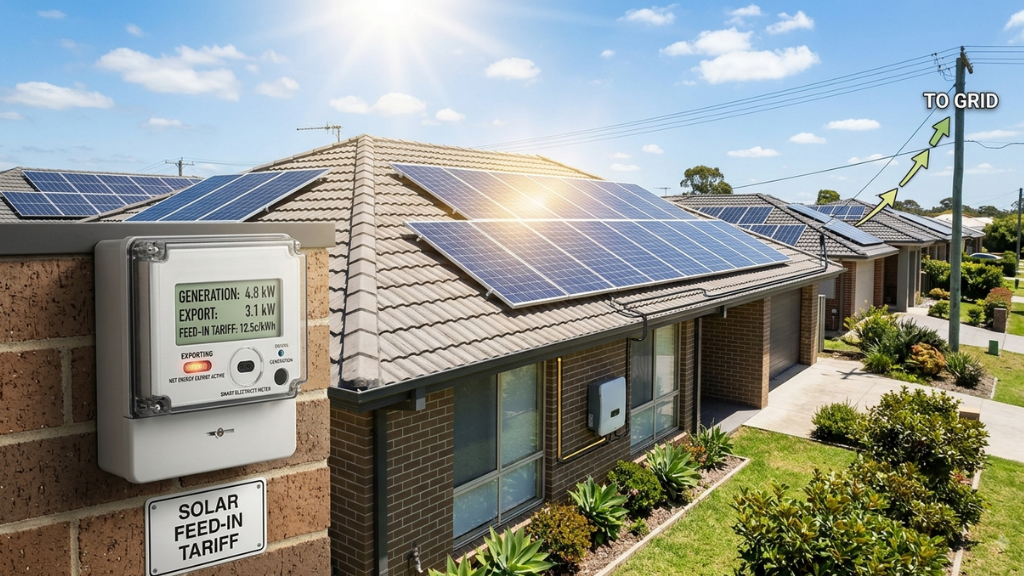
Solar panels do not necessarily reduce the amount of electricity your household’s appliances require. Instead, solar generation can reduce how much electricity you need to purchase from the grid.
For example, if your appliances use 20 kWh during a day and your solar system supplies 12 kWh directly to the home, the remaining grid requirement may be substantially lower.
This distinction is important when analysing an electricity bill:
Household electricity demand ≠ grid electricity purchased.
A home with solar may still have relatively high electricity demand while showing substantially lower grid imports.
Solar generation also varies according to weather, season, system size, orientation, shading and household usage patterns.
How can you reduce average household power consumption?
Reducing electricity use does not necessarily require replacing every appliance or making major changes to your home.
Start by identifying where electricity is actually being consumed.
1. Check your historical usage
Review at least 12 months of bills or meter data to identify seasonal patterns.
2. Identify high-energy appliances
Pay particular attention to heating, cooling, hot water, pool equipment and clothes dryers.
3. Reduce unnecessary standby consumption
Energy Made Easy states that standby power can account for up to 10% of household electricity use. Switching appliances off at the wall when they are not needed can therefore be a simple way to reduce unnecessary consumption.
4. Improve heating and cooling efficiency
Using heating and cooling systems efficiently can have a significant effect on electricity demand, particularly in homes with frequent air-conditioning use.
5. Consider appliance efficiency
When replacing an appliance, compare its energy-efficiency rating and expected energy consumption rather than considering purchase price alone.
6. Shift electricity use where appropriate
If your electricity plan has different peak, shoulder and off-peak rates, the timing of certain flexible loads may affect your electricity costs.
The important distinction is that changing when you use electricity can reduce your bill without necessarily reducing total kWh consumption.
What should you do if your electricity usage seems unusually high?
Do not assume that a high electricity bill automatically means your retailer is overcharging you.
First separate the issue into two questions:
How much electricity did I use?
and
How much did I pay for each unit of electricity?
A high bill can result from increased consumption, higher usage rates, higher supply charges, changes in discounts or concessions, or a combination of factors.
Energy Made Easy recommends using actual historical consumption where possible because generic benchmark usage can differ considerably from what a particular household actually consumes.
If your usage has suddenly increased, compare it with the same period from the previous year and investigate changes such as a new appliance, increased air-conditioning use, electric hot-water issues or changes in household occupancy.
The Australian average is less useful than your household benchmark
The phrase “average household power consumption” sounds like there should be one definitive Australian number.
In practice, there isn’t.
Australia has significant differences in climate, housing, household size, appliance ownership and electricity usage patterns. The Australian Energy Regulator’s benchmark system reflects this by comparing households according to factors including household size and location rather than treating every home as identical.
The Australian Government’s Australian Energy Statistics provide national energy-consumption data and are updated annually. The latest 2025 edition contains data through 2023–24 and is the authoritative national source for Australia’s historical energy statistics.
For an individual household, however, your own 12-month kWh history remains one of the most useful indicators of how much electricity you actually consume.