Table of Contents
Quick answer: Replace a solar inverter when it stops producing power, shows repeated fault codes, loses output for no clear reason, or is over 10 years old, out of warranty, and the repair quote is near half the cost of a new unit. For a like-for-like string unit, the typical solar inverter replacement cost in Australia is $1,500 to $3,500.
Key takeaways
- String inverters typically last 10 to 15 years, while solar panels keep working for 25+ years.
- Repeated fault codes, falling output and shutdowns on hot days are the most common early warnings.
- Repair only if the unit is under warranty, under about 7 to 8 years old, and has a single faulty part.
- Every new grid-connected inverter must comply with AS/NZS 4777.2:2020 Amd 2:2024, mandatory since 23 August 2025.
- Queensland 44c feed-in tariff customers must replace their inverter with one of the same or smaller capacity to keep the tariff until 1 July 2028.
What is a solar inverter?
A solar inverter converts the direct current (DC) produced by solar panels into the alternating current (AC) used by your home and the electricity grid. It also tracks system performance, sends data to your monitoring app, and shuts the system down safely when it detects a fault.
Since the solar inverter operates whenever sunlight reaches the panels, no other component in a home solar setup works quite as hard. When it slows down or stops, your panels may look fine while your savings quietly disappear.
How long does a solar inverter last?
Expect 10 to 15 years from a string inverter, with warranties generally covering 5 to 10 years. Microinverters, fitted behind each panel, usually outlast string inverters and often come with extended warranties.
Inverters fail before panels because their electronic components, such as capacitors, fans, and circuit boards, wear out with heat and daily use. Panels have no moving parts and lose efficiency slowly. Most households will therefore replace their inverter at least once during the panels’ lifespan. To see what to expect from the panels themselves, read how long solar panels last in Australia.
Installation location and quality make a real difference. A unit mounted in full afternoon sun runs hotter and ages faster than one on a shaded, ventilated wall. Humidity and salt air along the Queensland coast can let moisture into connections. Budget units tend to fail sooner, and an undersized inverter works harder every day.
Good to know: If your system was installed before 2015, it’s sensible to plan for a replacement now, even if it still appears to be working.
How do you know your solar inverter is failing?
The clearest signs are a blank screen or zero generation on a sunny day, the same fault codes returning, output that has dropped compared with last year, frequent shutdowns in hot weather, and buzzing, burning smells or scorch marks.
| Warning sign | What it usually means | What to do |
| Blank screen or zero generation on a sunny day | Tripped breaker, isolator off or inverter failure | Check the breaker and isolator, then book an inspection |
| Same fault code keeps returning | A part is wearing out | Note the code and book an inspection |
| Isolation or earth fault after rain | Moisture in DC wiring or isolators | Book an inspection promptly (safety issue) |
| Producing less power than this time last year | Inverter losing efficiency | Compare data, then have the system tested |
| Shuts down on hot days | Overheating or failing cooling | Check ventilation; book a check if it continues |
| Burning smell, scorch marks, loud buzzing | Component failure | Shut down safely and call a licensed electrician now |
Why does a blank screen not always mean the inverter has failed?
A tripped circuit breaker or switched-off isolator can sometimes explain why a solar inverter is not producing power. Check the inverter display and follow the manufacturer’s instructions, but do not open the inverter, remove covers or handle electrical wiring. If a breaker trips repeatedly, a fault appears after rain, or you notice a burning smell or scorch marks, keep clear and contact a licensed electrician. If you are unsure whether the system can be checked safely, arrange a professional inspection.
Which fault codes should you take seriously?
A one-off fault may come from the grid and never return. Repeated codes usually mean a part is wearing out. Faults that mention insulation, isolation, earth or temperature deserve attention, and an isolation or earth fault after rain often signals moisture in the DC wiring, which is a safety issue as well as a performance one.
How do you spot an inverter that’s underperforming over time?
Compare this month’s generation in your monitoring app with the same month last year. If output is clearly lower and there’s no new shade, dirt or cloudy weather to blame, the inverter may be underperforming. A rising power bill with no change in how you use electricity is often the first clue.
What’s the safe response to a burning smell or visible scorch marks?
Don’t open the inverter. Follow the shutdown procedure on the label near your inverter or switchboard, keep clear, and call a licensed solar electrician straight away.
Should you repair or replace a solar inverter?
Repair the inverter if it is under warranty, less than about 7 to 8 years old, and the fault is a single replaceable part such as a fan, isolator or cable. Replace it if it is out of warranty, faults keep returning, parts are unavailable, or the repair costs close to half the price of a new unit.
The half-the-cost rule exists because spending that much on an ageing inverter only buys a few more years of life. A replacement solar inverter resets the clock with a fresh warranty, better efficiency and more detailed monitoring.
Can you get help if your original solar installer has closed?
Yes. Consumer advocates estimate that hundreds of thousands of Australian solar systems have been left without their original installer after companies closed or stopped trading. Manufacturer warranties may still apply, and you may have rights under Australian Consumer Law. A local, licensed installer can inspect the system, help with any remaining warranty claim, and take over ongoing support.
How much does a solar inverter replacement cost in Australia?
Most Australian homes pay $1,500 to $3,500 for a like-for-like string inverter replacement, and $2,500 to $4,500 for a battery-ready hybrid inverter. Microinverters cost about $150–$250 per unit, plus labour.
| Replacement type | Typical installed cost | Best suited to |
| String inverter, like-for-like (5–6.6 kW) | $1,500 – $3,500 | Most homes with no plans for a battery |
| Hybrid (battery-ready) inverter | $2,500 – $4,500 | Homes likely to add a battery |
| Microinverter | $150 – $250 per unit, plus labour | Systems that already use microinverters |
The final solar inverter replacement cost depends on the brand and size of the unit, plus any extra work. New DC isolators, fresh cabling, a switchboard upgrade or moving the inverter to a cooler spot add to the cost, and two-storey or hard-to-reach installs can add labour. Every replacement also includes setting the inverter to the correct grid settings and notifying your electricity network.
Ask for a written quote that lists the inverter, isolators, labour, compliance certificates and network notification separately so you can compare quotes like-for-like.
Should your new inverter be a hybrid model?
A hybrid solar inverter may be a good choice if you plan to add a compatible home battery, particularly when replacing your existing inverter and battery at the same time. However, a hybrid inverter is not your only option. An AC-coupled battery system uses a separate battery inverter, which can often be added while keeping your existing solar inverter. The best option depends on your current equipment, battery compatibility, installation costs, energy efficiency and backup power requirements. Ask a qualified installer to compare both options before deciding.
The federal Cheaper Home Batteries Program, which began on 1 July 2025, discounts the battery itself, not the inverter. From 1 May 2026, the full discount applies to the first 14 kWh of battery capacity, smaller discounts apply above that, and the rate steps down every six months. Our page on batteries for solar panel systems explains your storage options.
Can you replace your inverter and keep the Queensland 44c feed-in tariff?
Yes, if the replacement solar inverter has the same capacity as the one originally approved, or less. Increasing inverter capacity, adding panels beyond the approved capacity, or adding a battery in a configuration the scheme doesn’t allow can end the 44c tariff early.
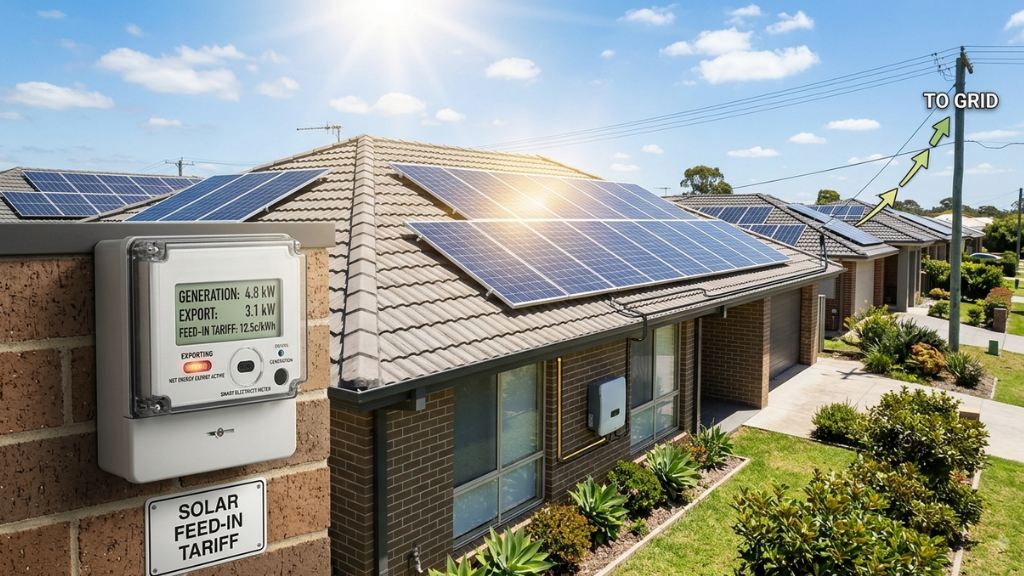
The Queensland Solar Bonus Scheme pays 44c per kWh to customers who applied before 10 July 2012 and have stayed eligible, until the scheme ends on 1 July 2028.
Tell your installer you’re on the 44c tariff before they quote. If you receive the 44c tariff, discuss the impact of any proposed inverter, panel or battery upgrade with your electricity distributor before proceeding. A like-for-like inverter replacement may help preserve eligibility, while other upgrades require careful assessment against the scheme rules. with bigger upgrades such as more panels or a battery left until mid-2028. For more on the 44c scheme and how feed-in tariffs compare, see our guide to best solar feed-in tariffs.
What happens during a solar inverter replacement?
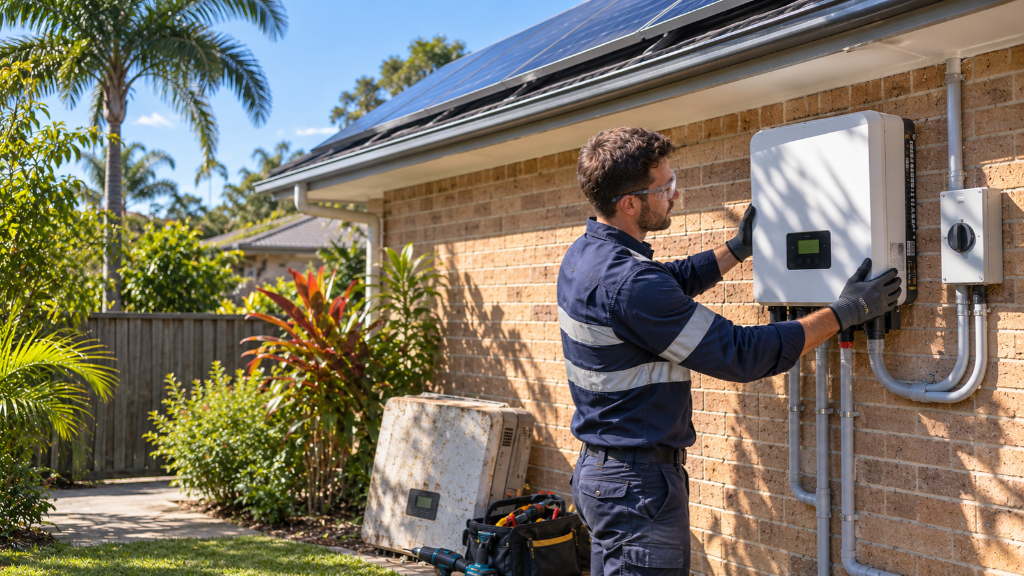
A licensed electrician inspects the system, provides a quote, lodges the change with your network, installs and commissions the new inverter, then issues a safety certificate. The installation itself usually takes less than a day.
- Inspection: A licensed electrician checks the inverter, panels, wiring and isolators to confirm the inverter really is the problem.
- Quote and recommendation: You choose from a like-for-like swap, a larger unit where your network and tariff rules allow it, or a hybrid.
- Network approval: Your installer lodges the change with your electricity network, which is Energex or Ergon Energy Network in Queensland.
- Installation: The old inverter comes off the wall, and the replacement solar inverter is mounted and wired.
- Commissioning: The installer applies the correct grid settings, tests the system and connects it to your monitoring app.
- Paperwork: You receive an electrical safety certificate and warranty details. Register the warranty with the manufacturer straight away.
Who is allowed to replace a solar inverter?
In Australia, only licensed electricians can work on solar inverters. Look for an installer accredited by Solar Accreditation Australia (SAA), and make sure the new inverter appears on the Clean Energy Council’s approved inverter list.
Book a solar inverter inspection with SPS Energy
If your inverter is showing any of these signs, or it’s more than 10 years old, an inspection will tell you whether you need a repair, a like-for-like replacement or an upgrade. SPS Energy has worked in solar for more than 30 years from Eumundi on the Sunshine Coast, and our licensed, SAA-accredited team can inspect and service your system, no matter who installed it.
Book Now or call (07) 5442 7608.