Table of Contents
If you’re investing in solar panels — or already have them on your roof — the question you’ll eventually ask is a simple one: how long will these actually last?
It’s a fair question worth a straight answer. Most quality solar panels installed in Australia today will give you 25 to 30 years of useful power generation, and many will keep producing electricity well beyond that. They don’t suddenly switch off at the 25-year mark — they just gradually produce a little less over time. That slow decline is called degradation and understanding it is the key to understanding what you’re actually getting from your solar investment.
Australia’s climate makes this question a little more layered than in other countries. We get more sunlight than almost anywhere on earth — which is exactly why solar performs so well here — but extreme heat, UV intensity, hailstorms, and coastal salt air all interact with panel longevity in ways that are worth knowing about before you buy or replace.
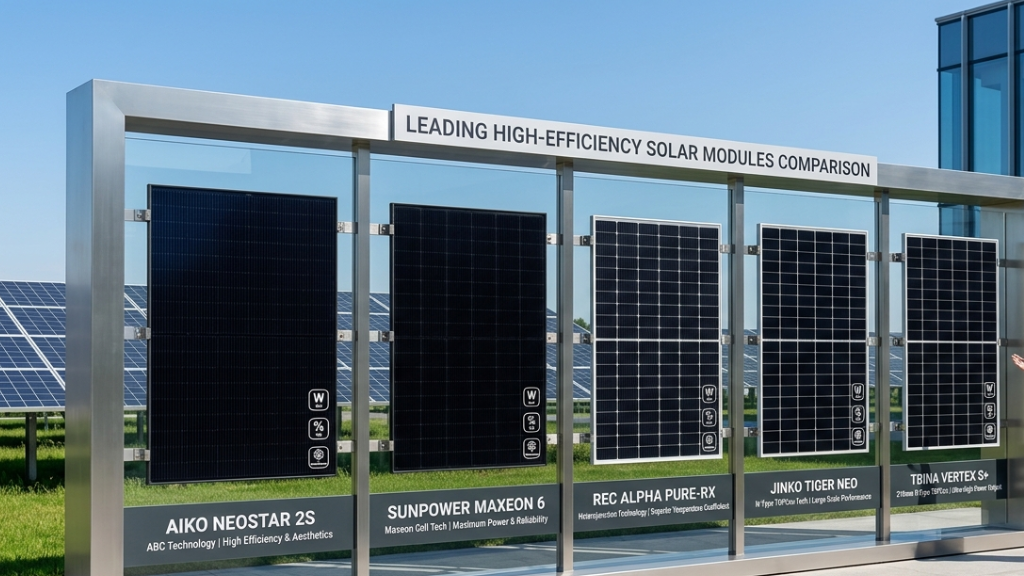
This guide covers everything: how panels age, what the research says about modern degradation rates, what your warranties actually mean (and which one matters more than you think), and how to get the most years possible out of your system. If you’re still researching equipment, it’s also worth comparing the Best Solar Photovoltaic Panels available in Australia before making a long-term investment
How Long Do Solar Panels Last?
Solar panels in Australia typically last between 25 and 30 years. Quality panels from reputable manufacturers maintain around 80–85% of their original output by the end of that period. They don’t stop working abruptly — they slowly produce less electricity over time through a process called degradation.
What Does “Last” Actually Mean for Solar Panels?
This is worth pinning down early. Solar panels don’t fail the way a TV or washing machine does. There’s no moment when they stop working and need to be replaced.
Instead, they lose a small percentage of their output each year. The solar industry defines the practical end of a panel’s useful life as the point when its output drops below 80% of its original rated capacity. Most performance warranties are structured around this threshold — your panels are typically warranted to produce at least 80–85% of their rated output by year 25.
What this means in practice:
- A 400W panel at year 25 might be producing around 320–340W under the same conditions it was rated for on day one.
- That’s still a lot of useful power.
- Your panels haven’t “broken” — they’re just aging the way all technology does.
Whether to replace panels at or before this point is ultimately your call. Many homeowners choose to keep running older systems because the electricity savings still outpace the cost of replacement. Others upgrade to take advantage of higher-efficiency modern panels. Both are perfectly reasonable approaches.
How Solar Panels Age: Understanding Degradation
The First-Year Drop
Every solar panel experiences its most significant performance dip in its first year — typically a loss of 1–2% of rated output. This is largely caused by a phenomenon called Light-Induced Degradation (LID), which occurs within the first few days of sun exposure as the panel’s silicon stabilises. After that initial adjustment, LID effectively stops.
Annual Degradation After Year One
From year two onwards, quality panels degrade at a much slower, steadier rate. According to data from the National Renewable Energy Laboratory (NREL) in the United States — the most widely cited source on solar panel longevity — the average degradation rate across all panel types is approximately 0.5% per year. That figure has been improving over time: back in 2012, NREL put it at around 0.8%.
In practical terms, a 0.5% annual degradation rate means a panel producing 400W at installation would still produce around 350W after 25 years — roughly 87.5% of its original output.
Premium panels perform even better. Research and real-world data consistently shows that top-tier manufacturers like SunPower Maxeon and REC Alpha degrade at rates as low as 0.25% per year. At that rate, after 25 years those panels are still producing around 93% of their original output — a meaningfully different outcome over a system’s lifetime.
2026 Benchmarks for Australian Panels
The degradation landscape has shifted significantly in recent years. For panels being installed on Australian rooftops right now, the benchmark figures look like this:
| Panel Tier | Typical Annual Degradation | Output at Year 25 |
| Budget / entry-level | 0.7–1.0% | 75–82% |
| Mid-range (most Tier-1 brands) | 0.4–0.5% | 87–90% |
| Premium (REC, SunPower Maxeon, Aiko) | 0.25–0.35% | 91–94% |
Source: SolarQuotes degradation comparison data, 2026; NREL research data.
Five years ago, 0.7% was the standard expectation for a decent panel. The industry has improved substantially, and the difference between a budget panel and a premium one — calculated across 25+ years of output — is significant.
What Affects How Long Solar Panels Last?
Degradation rate is the headline number, but several other factors determine how long your specific panels will remain useful and efficient.
1. Panel Quality
This is the single biggest variable. Quality panels are built with premium materials, tighter manufacturing tolerances, and more rigorous testing. They resist microcracks, UV discolouration, and moisture ingress better than budget alternatives. The correlation between panel quality and longevity is well established — and it’s why the warranty terms offered by premium manufacturers are genuinely longer and more meaningful.
Choosing a reputable brand with local Australian support matters here too. A warranty is only as valuable as the manufacturer’s ability to honour it. A company that exits the Australian market — and it does happen — leaves you with warranty paperwork but no recourse.
2. Installation Quality
Poor installation is one of the leading causes of premature panel degradation. Issues introduced at install include:
- Microcracks from incorrect handling or mounting pressure, which spread over time and reduce cell efficiency
- Inadequate ventilation leaving panels running hotter than designed, accelerating degradation
- Incorrect wiring leading to hot spots that permanently damage cells
- Substandard mounting that allows panels to flex in wind, stressing connections over years
An accredited CEC (Clean Energy Council) installer with a solid track record isn’t just a checkbox — it’s one of the most important decisions you’ll make for long-term system performance. A quality Solar Panel Installation helps minimise future performance issues and ensures your system operates efficiently for decades.
3. Australian Climate Conditions
Australia’s solar resource is world-class, but the climate does place specific demands on panels:
- Extreme heat: High temperatures accelerate thermal expansion and contraction cycles, stressing frame seals and cell connections over time. Queensland and the Northern Territory are particularly demanding in this respect.
- UV intensity: Australia’s UV levels are among the highest in the world. Over years, intense UV exposure can degrade encapsulants and backing materials, leading to discolouration and reduced light transmission.
- Hailstorms: Most quality panels are rated to IEC hail resistance standards (typically 25mm at 23 m/s), but larger hail events can cause physical damage. Sydney and Brisbane are hail-prone areas.
- Coastal salt air: Homes within a few kilometres of the coast need panels with enhanced corrosion resistance. Salt particles carried by sea breezes accelerate corrosion of frames, connectors, and mounting hardware.
- Dust and soiling: In drier inland areas, dust accumulation can be significant. Dirty panels don’t just lose output temporarily — consistent soiling can create uneven heating patterns that stress cells over time.
Cooler, temperate climates tend to be kinder to panels than hot ones. Research data supports this: studies have found that solar systems in cooler conditions degrade at roughly 0.48% per year, while those in hotter climates average around 0.88%.
4. Shading
Consistent shading causes panels to work harder than they should, creating thermal stress and accelerating degradation. If trees have grown to shade your roof since your system was installed, it’s worth addressing. Modern systems using microinverters or DC optimisers are more resilient to shading than older string inverter setups — but no system performs well with chronic shading.
5. Maintenance
Panels require very little ongoing attention — but completely ignoring them isn’t free. Understanding basic Solar Panel Maintenance requirements can help maximise energy production and extend the lifespan of your system. Dust, bird droppings, leaf matter, and grime reduce output and, if allowed to accumulate into heavy soiling, can create localised hot spots. A clean every one to three years (more often in dusty or urban areas) and a professional inspection every few years to check electrical connections, mounting hardware, and inverter performance will meaningfully extend your system’s useful life. If you’re unsure where to start, our guide on How to Clean Solar Panels explains the safest and most effective cleaning methods.
The Inverter: The Part That Won’t Last as Long
Here’s something many solar buyers don’t factor in when thinking about system lifespan: your inverter will likely need replacing before your panels do.
While solar panels are rated for 25–30 years, standard string inverters typically last 10–15 years. They work hard — converting DC power from your panels into usable AC electricity every single hour of sunlight, day in, day out — and the electronics simply wear out faster than passive panel components.
Most inverter warranties run 5–12 years, with some premium brands offering 15 years. You should budget for at least one inverter replacement over your solar system’s lifetime.
Microinverters — small inverters mounted behind each individual panel rather than as a single central unit — are an exception. They tend to carry longer warranties (often 25 years), partly because they operate at lower temperatures and distribute the load.
If your system seems to be underperforming but your panels appear clean and undamaged, the inverter is usually the first thing to check. Choosing from the Best Solar Inverters available today can significantly improve system reliability and monitoring capabilities.
Understanding Solar Panel Warranties in Australia
Warranties cause a lot of confusion in the solar industry. There are three distinct types covering your system, and they protect you in very different ways.
1. Product Warranty (The One That Really Matters)
The product warranty covers manufacturing defects and workmanship failures — the physical integrity of the panel itself. If your panel cracks, delaminates, corrodes abnormally, or stops working for any reason tied to how it was made, this is the warranty you’ll claim.
Product warranties currently range from 10 to 25 years, with some premium brands (SunPower Maxeon) now offering up to 40 years. In Australia, it’s mandatory for panels to carry a minimum 25-year performance warranty, but the product warranty is a separate and — for most practical purposes — more important commitment from the manufacturer.
Industry consensus is clear: a product warranty under 12 years should be a red flag heading into 2026. Premium panels competing in the Australian market now offer 25-year product warranties as standard.
2. Performance Warranty (Often Misunderstood)
The performance warranty guarantees that your panels will produce at least a specified percentage of their rated output at a given point in time — typically promising 80–85% output at the 25-year mark.
In Australia, a 25-year performance warranty is a legal minimum, not a differentiator. Every panel sold here has one. The key number to compare across brands is not whether they have a performance warranty, but the warranted annual degradation rate — the smaller the number, the better.
One important practical note: performance warranties are notoriously difficult to enforce. Successfully claiming one requires proving that your panels are underperforming relative to their warranty specification, accounting for all external variables like shading and soiling. Many industry experts describe the performance warranty as more of a marketing tool than a practical consumer protection mechanism.
3. Workmanship (Installation) Warranty
This comes from your installer, not the panel manufacturer. It covers issues arising from how the system was installed — incorrect wiring, poor mounting, roof penetration leaks, and so on. Quality Australian installers typically offer 5–10 years of workmanship warranty.
This warranty is where your installer’s longevity and reputation matter. An installer who has been in business for years and has local roots is far more likely to still be around to honour a workmanship claim than a fly-by-night operation.
Your Rights Under Australian Consumer Law
Independent of manufacturer warranties, solar panels purchased in Australia are covered by the Australian Consumer Law, which provides automatic guarantees that products will work as expected and last as long as a reasonable person would expect. If your panels fail well before a reasonable lifespan has passed — regardless of what the warranty says — you may have grounds for a consumer claim against the retailer or manufacturer.
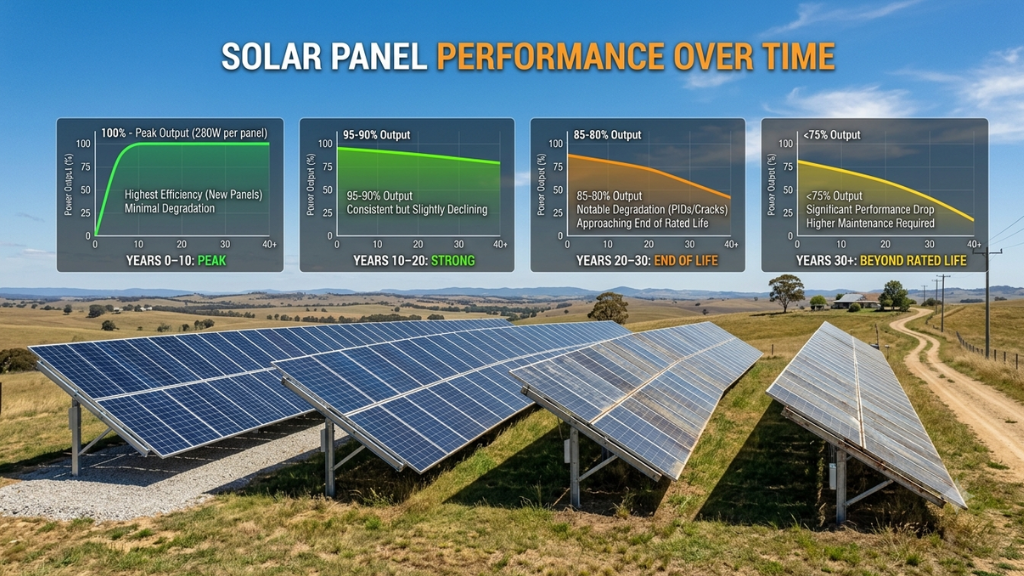
Solar Panel Performance Over Time: What to Expect at 10, 20, and 25+ Years
Understanding what your system should look like at different ages helps you identify genuine problems versus normal aging.
Years 0–10: Peak performance
Your system should be operating close to its rated capacity. Energy bills should reflect strong generation throughout this period. At the 5-year mark, many Australian homeowners have already recovered a large portion of their upfront system cost.
Years 10–20: Strong but slightly declining
Output will have dropped a few percent from peak, but most well-maintained systems are still delivering excellent savings. Panels installed in the early 2010s are still performing strongly, particularly those from quality manufacturers. Your inverter warranty may have expired by this point — monitor its performance and budget for potential replacement.
Years 20–30: Approaching end of rated life
Generation output has declined noticeably from day one, but quality panels are still producing 85–90% of their original rated output. Whether to replace or continue depends on your energy needs, available panel technology at the time, and whether other system components need attention. Many homeowners find the maths still favours running an older system rather than replacing it.
Years 30+: Beyond rated life
Panels can and do continue producing electricity past 30 years. They just produce less. Several solar systems installed in Australia in the 1990s are still generating power. Whether it makes sense to keep running them depends entirely on output levels and your circumstances.
Signs It Might Be Time to Replace Your Solar Panels
Panels don’t come with a warning light. Here’s what to watch for:
- Noticeably higher electricity bills despite similar usage patterns and no change in grid electricity rates — a sign generation has fallen meaningfully
- Monitoring data showing a sustained drop in generation compared to previous years, beyond what normal seasonal variation explains
- Visible physical damage: cracks in the glass, discolouration, delamination (the layers of the panel separating), browning or yellowing, or rust on frames
- Hot spots detected on thermal imaging — these indicate damaged cells that are generating heat instead of electricity and will worsen over time
- Inverter showing persistent fault codes related to panel array performance rather than inverter-specific issues
If your panels are approaching or past 25 years and generation has dropped significantly, it’s worth getting a professional assessment. In many cases, replacing an aging system with modern panels will substantially increase generation — today’s panels are considerably more efficient than those installed a decade ago.
How to Maximise the Lifespan of Your Solar Panels
Most of what determines solar panel longevity is decided at two points: when you choose which panels to buy, and when they’re installed. But there’s still meaningful maintenance that influences how many useful years you get.
Buy quality from the start. Premium panels degrade slower, are built to withstand Australian conditions, and come with warranties backed by manufacturers who will still exist in 25 years. The price difference between mid-range and premium panels is real, but so is the difference in lifetime output.
Use an accredited, reputable installer. CEC accreditation is the minimum standard. An installer with local roots, a verifiable track record, and genuine experience in your climate conditions is the best protection against installation-related degradation.
Keep panels clean. A simple rinse with a garden hose — without abrasive materials — is sufficient for most residential systems. Annual cleaning is a reasonable baseline; more frequent in dusty locations or under trees. Avoid high-pressure washers, which can damage seals.
Monitor your system’s output. Modern inverters provide monitoring data you can check via an app. Knowing your typical daily generation allows you to spot drops early, before they compound.
Schedule professional inspections every few years. A qualified solar technician can identify loose connections, micro-cracks (visible under UV inspection), mounting issues, and early inverter problems that aren’t visible to the naked eye.
Address shading promptly. If trees have grown near your panels since installation, trimming or removing branches isn’t just about short-term generation — it reduces long-term thermal stress too.
Plan for inverter replacement. It’s not an emergency when an inverter reaches the end of its life, but it pays to have a replacement budget in mind. Upgrading to a premium inverter when the time comes can also improve whole-system performance.
Solar Panel Lifespan in Queensland: What the Local Climate Means for You
Queensland sits at the extreme end of Australia’s solar potential — and also its climate demands. The Sunshine Coast and surrounding regions like Eumundi receive exceptional solar irradiance year-round, making solar one of the strongest financial investments available to homeowners and businesses in the region.
At the same time, Queensland’s climate includes:
- High UV intensity accelerating encapsulant aging
- Hot summers creating significant thermal cycling stress
- Seasonal hailstorms requiring panels tested and rated for impact resistance
- Subtropical humidity demanding well-sealed electrical components
The practical implication: panel quality and installation quality matter even more here than in cooler, more temperate states. Homeowners should also carefully consider What Size Solar System Do I Need? to ensure their system can meet future energy demands while maximising available roof space. A panel that performs adequately in Melbourne may degrade faster in Rockhampton or Cairns. Experienced local installers who understand Queensland’s specific conditions — and who specify panels tested for those conditions — deliver meaningfully better long-term outcomes than those who apply a one-size-fits-all approach.
For Sunshine Coast homeowners, Eumundi averages around 7.3 hours of peak sunlight daily — one of the highest figures in Australia. That’s excellent news for the return on your solar investment, and a reason to choose panels that can handle sustained high-intensity UV exposure over a 25-year lifespan.
Key Takeaways
- Quality solar panels installed in Australia last 25 to 30 years, with many continuing to produce electricity well beyond that.
- Panels don’t stop working suddenly — they degrade gradually, losing a small percentage of output each year. The industry defines end-of-useful-life as output falling below 80% of rated capacity.
- Average annual degradation is around 0.5% per year for standard panels; premium panels (REC Alpha, SunPower Maxeon, Aiko) degrade at as little as 0.25% per year.
- The first year sees the steepest drop (1–2%), mainly due to Light-Induced Degradation. This then stabilises.
- Inverters last 10–15 years — shorter than panels — and should be budgeted for replacement.
- There are two warranties that matter: the product warranty (which covers physical defects — the one you’ll actually claim) and the performance warranty (a legal minimum in Australia, less enforceable in practice).
- Panel quality, installation quality, climate, shading, and maintenance all significantly affect real-world lifespan.
- Queensland’s high UV and heat levels make panel selection and installer quality especially important for long-term performance.
- Regular cleaning, monitoring, and inspections every few years are the most effective maintenance steps for maximising system longevity.
Conclusion
Solar panels in Australia are genuinely long-lasting assets. A quality system, installed correctly by an experienced professional, will deliver clean energy for 25 to 30 years — with most panels still producing meaningfully above 80% of their original output at the end of that period. The technology keeps improving too, so the panels going on rooftops right now will likely outperform the real-world longevity statistics established by older installations.
The factors that matter most are the ones you control at the start: the brand and quality of panels you choose, the reputation and experience of your installer, and the specific demands of your local climate. Once your system is running, staying on top of basic maintenance and monitoring gives you the best chance of reaching — and exceeding — that 25-year benchmark.
How long do solar panels last? Long enough to transform the economics of your electricity bill, reduce your environmental footprint, and deliver returns on your investment for decades. The key is making smart choices at the beginning.
Ready to find out what a quality solar system looks like for your home or business?
Request a free assessment from SPS Energy.